
Learn About Synthetic Cannabinoids
K2 Herbal Incense in Europe
Sep
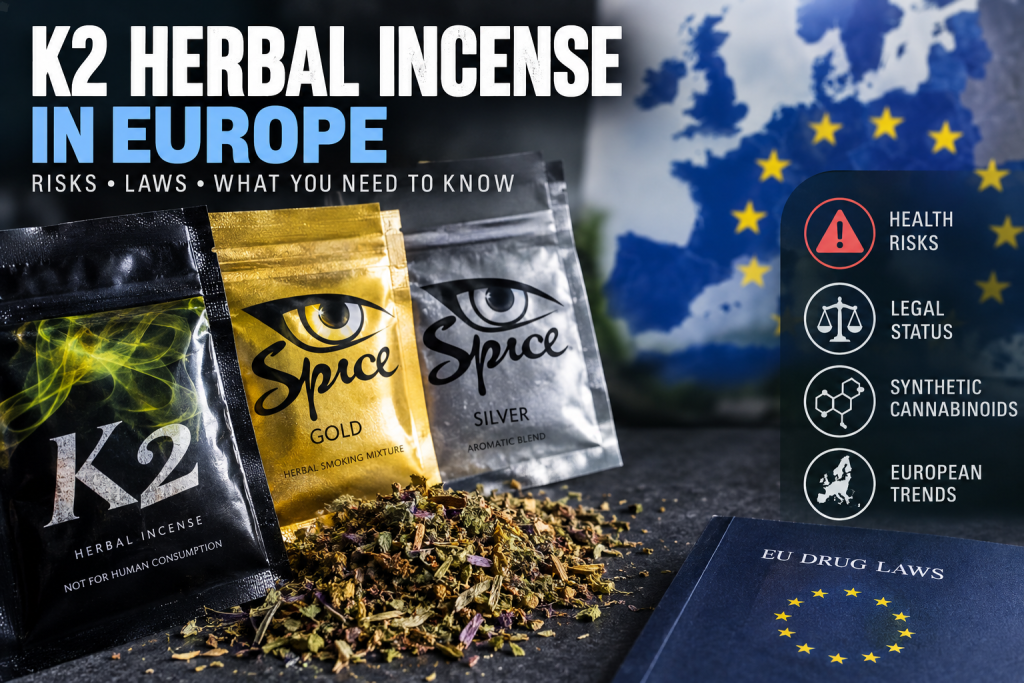
K2 Herbal Incense in Europe: Risks, Laws, and What You Need to Know
K2 herbal incense has become a widely recognized term for products associated with synthetic cannabinoids. In Europe, similar products are often referred to as Spice, synthetic cannabis, herbal smoking mixtures, or new psychoactive substances.
Despite names such as “herbal incense,” these products should not be confused with ordinary aromatic herbs or natural cannabis. In many cases, the plant material simply acts as a carrier for laboratory-made chemicals that interact with cannabinoid receptors in the body.
European authorities continue to monitor synthetic cannabinoids because their chemical compositions change rapidly, their effects can be unpredictable, and new substances regularly appear on the market. According to the European Union Drugs Agency (EUDA), highly potent synthetic cannabinoids remain an important poisoning risk in Europe.
What Is K2 Herbal Incense?
K2 is not one single chemical substance.
The term has historically been associated with mixtures containing synthetic cannabinoid receptor agonists. In Europe, the name Spice has traditionally been more common, although numerous product names have appeared over the years.
Synthetic cannabinoids are chemicals designed to interact with some of the same cannabinoid receptors affected by THC, the main psychoactive substance in cannabis.
However, that does not mean K2 or Spice is simply synthetic marijuana.
The pharmacology can be significantly different. Some synthetic cannabinoids act more strongly at cannabinoid receptors than THC, which may contribute to more unpredictable and sometimes severe reactions.
The EUDA reports that synthetic cannabinoids began appearing in European herbal mixtures around 2008. Early products included names such as Spice Gold and Spice Silver. Since then, hundreds of products and numerous synthetic cannabinoid compounds have appeared.
Why Is It Called Herbal Incense?
Marketing terminology has played an important role in the history of these products.
Packages have sometimes been described as:
Herbal incense, aromatic blends, room odorisers, herbal mixtures or collector products.
However, those descriptions do not reliably indicate what chemicals are actually present.
In traditional synthetic cannabinoid products, dried plant material may be treated with psychoactive chemicals. As a result, the herbs themselves are not necessarily responsible for the intoxicating effects.
One major problem is that the chemicals may not be distributed evenly throughout the material.
The EUDA warns that this can create areas of particularly high concentration, sometimes described as “hot pockets,” which can substantially increase poisoning risks.
K2 and Spice Are Not the Same as Cannabis
Cannabis naturally contains cannabinoids such as THC and CBD.
Traditional K2 or Spice products typically involve entirely different synthetic compounds designed to activate cannabinoid receptors.
Consequently, someone cannot reliably predict the effects of a K2-type product based on their previous experience with cannabis.
Two packages with similar branding may contain completely different substances.
Even two batches carrying the same name may differ in:
Chemical composition, concentration, potency and contaminants.
This unpredictability is one of the major public-health concerns surrounding synthetic cannabinoids in Europe.
Health Risks Associated With Synthetic Cannabinoids
Synthetic cannabinoid poisoning can range from relatively mild symptoms to medical emergencies.
Frequently reported effects include agitation, nausea and unusually rapid heartbeat. More serious reactions reported in connection with synthetic cannabinoids include seizures, psychosis, kidney injury, stroke, heart problems and prolonged vomiting. Fatal poisonings have also been documented.
Psychological reactions may include severe anxiety, paranoia, confusion, hallucinations and unpredictable changes in behaviour.
The risks can be difficult to estimate because the chemical contained in a particular product may not be disclosed accurately—or disclosed at all.
This makes packaging, branding or appearance an unreliable way of determining what a product contains.
Synthetic Cannabinoids in Europe in 2026
Europe’s synthetic cannabinoid market continues to evolve.
According to the European Drug Report 2026, European countries identified 27 new cannabinoids during 2025, including 16 semi-synthetic cannabinoids.
Authorities have also raised concerns about synthetic cannabinoids being unexpectedly present in other products, including low-THC cannabis, CBD-related products and certain e-liquids.
An important recent example occurred in September 2025, when Czech authorities reported an outbreak of poisonings associated with the synthetic cannabinoid MDMB-PINACA in products marketed in the style of so-called legal highs.
These developments demonstrate why terms such as K2, Spice or herbal incense cannot identify a specific chemical with certainty.
New Synthetic and Semi-Synthetic Cannabinoids
Europe is also dealing with another rapidly changing category: semi-synthetic cannabinoids.
These compounds are different from traditional Spice-type synthetic cannabinoids, although consumers may encounter them in overlapping markets.
Examples include substances related to HHC and newer cannabinoid derivatives.
By the end of 2025, EUDA reported that 40 semi-synthetic cannabinoids had been identified on European drug markets. HHC itself was placed under international control in December 2025.
As controls expand, new chemical alternatives can appear.
This constant change creates challenges for laboratories, healthcare providers, regulators and consumers.
Is K2 Herbal Incense Legal in Europe?
There is no single answer covering every European country and every substance marketed as K2.
Legal status depends on several factors, including:
The exact chemical involved, national drug legislation, whether generic or analogue controls apply and whether the substance has been placed under EU or international control.
Therefore, describing K2 or herbal incense generally as a “legal high” can be misleading.
Within the European Union, authorities operate an early-warning, risk-assessment and control system for new psychoactive substances. EU legislation also provides a framework through which dangerous new psychoactive substances can be brought within drug-control measures.
Individual countries may also impose broader national restrictions.
Consequently, a substance that was previously uncontrolled can later become illegal, while newly developed chemicals may appear before lawmakers have specifically addressed them.
Anyone needing legal information about a particular compound should consult the current legislation or official drug authority for the relevant country rather than relying on product labels or online descriptions.
Why the Term “Legal High” Is Misleading
The expression “legal high” was heavily used during the early development of the new psychoactive substances market.
Today, it is increasingly inaccurate.
A product being offered openly does not automatically make its contents legal.
Likewise, labels such as “not for human consumption,” “herbal incense” or “research product” do not establish that the chemicals inside are permitted under national law.
European authorities have progressively introduced legislative and regulatory controls specifically designed to respond more quickly to newly emerging psychoactive substances.
Another Concern: Products May Be Mis-Sold
One emerging European concern is people consuming synthetic cannabinoids without realizing it.
EUDA and Europol have reported cases where synthetic cannabinoids have appeared in products represented as THC, cannabis or CBD-related products.
Low-THC cannabis contaminated or deliberately treated with synthetic cannabinoids has also been detected in multiple European countries.
This matters because someone expecting the effects associated with ordinary cannabis may instead be exposed to a considerably more potent substance.
Signs of a Possible Medical Emergency
Because the contents and potency of synthetic cannabinoid products are unpredictable, serious reactions require prompt medical attention.
Symptoms such as seizures, loss of consciousness, severe agitation, difficulty breathing, severe chest pain, collapse or extreme confusion should be treated as emergencies.
Emergency medical services should be contacted according to the local emergency system of the country concerned.
Healthcare professionals should also be told, when possible, that exposure to a synthetic cannabinoid or unknown herbal mixture may have occurred.
Frequently Asked Questions About K2 Herbal Incense in Europe
What is K2 herbal incense?
K2 generally refers to products associated with synthetic cannabinoids. These chemicals may be applied to dried plant material and sold using terminology such as herbal incense or herbal mixture.
Is K2 the same as Spice?
The names are often used for broadly similar categories of synthetic cannabinoid products. “Spice” has historically been particularly common in Europe, while “K2” became widely recognized internationally.
Is K2 natural?
The plant material may be natural, but the substances responsible for the psychoactive effects are commonly synthetic chemicals.
Is K2 the same as marijuana?
No. Although synthetic cannabinoids interact with some of the same receptors as THC, their chemical structures, potency and effects can differ substantially from natural cannabis.
Is K2 legal throughout Europe?
No single legal status applies to every European country or every cannabinoid. Many synthetic cannabinoids are controlled, and additional substances can become controlled as authorities identify new risks.
Why can synthetic cannabinoid products be dangerous?
Their chemical identity and concentration may vary considerably between products and even between portions of the same product. Some synthetic cannabinoids are also highly potent, increasing the possibility of severe poisoning.
Are synthetic cannabinoids still found in Europe?
Yes. Although the market has changed considerably, the European Drug Report 2026 continues to identify highly potent synthetic cannabinoids and newly emerging cannabinoid substances as public-health concerns.
Final Thoughts
K2 herbal incense in Europe is best understood as part of the wider synthetic cannabinoid and new psychoactive substance market rather than as one specific product.
Names such as K2, Spice and herbal incense provide very little information about the actual chemical composition of a package.
European monitoring has repeatedly shown that the market changes quickly. New cannabinoids emerge, substances are placed under control, manufacturers switch chemicals, and products may contain substances that consumers were not expecting.
For that reason, neither attractive packaging nor terms such as “herbal,” “incense” or “legal” should be interpreted as evidence that a product is safe or legally permitted.
The most reliable information comes from national drug authorities, healthcare services and organisations such as the European Union Drugs Agency, which continues to monitor synthetic cannabinoids and other new psychoactive substances throughout Europe.

Pingback: Herbal Incense Blends: Synthetic Cannabinoid Infusion & Potency
Pingback: JWH-018 & the JWH Series: Origins, Chemistry & 2026 Context
Pingback: Synthetic Cannabinoids and the Liver: K2, Spice Toxicity Risks