Learn About Synthetic Cannabinoids
K2 Herbal Incense in the UK
Sep
K2 Herbal Incense in the UK: Spice, Risks, Laws and Facts
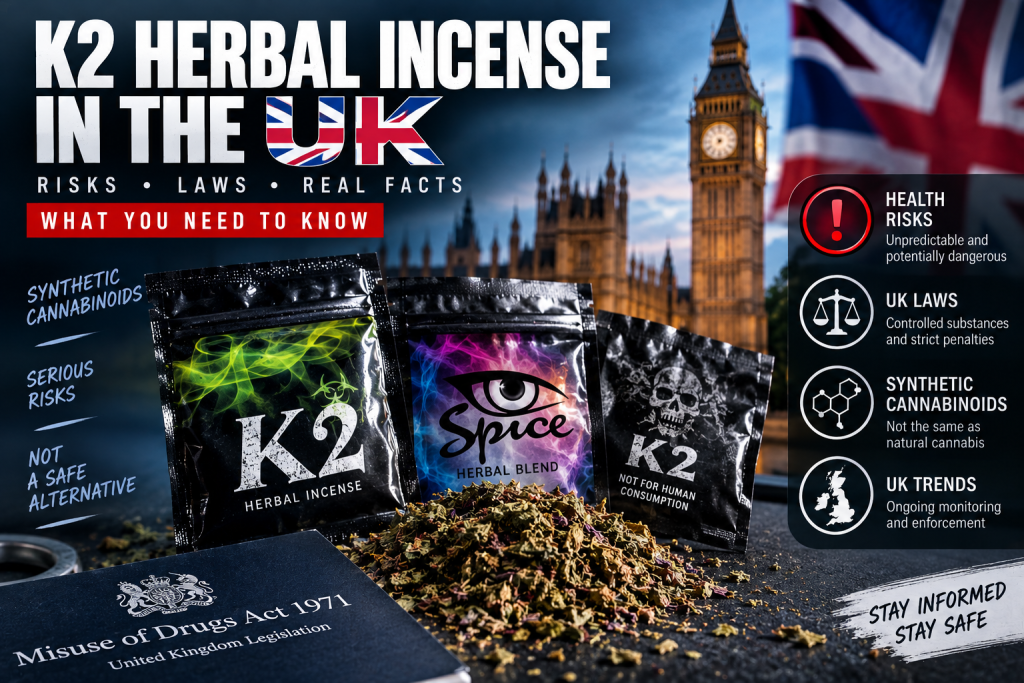
K2 herbal incense in the UK is generally associated with products containing synthetic cannabinoids—laboratory-made substances designed to affect cannabinoid receptors in the brain and body. In Britain, the term Spice is considerably more common than K2, while names such as synthetic cannabis, synthetic cannabinoids and Mamba are also used.
Despite being described historically as “herbal incense,” these products should not be confused with ordinary incense, herbal smoking products or natural cannabis.
The dried plant material found in some K2 or Spice products may simply serve as a carrier for synthetic cannabinoid chemicals. Consequently, the appearance, smell or packaging of a product cannot reliably tell someone what chemicals it contains or how potent it may be.
Synthetic cannabinoids are also subject to strict UK drug laws. Many substances commonly associated with Spice and K2 are controlled as Class B drugs under the Misuse of Drugs Act 1971.
What Is K2 Herbal Incense?
K2 is a broad street and marketing term rather than the name of one chemical.
Products historically marketed as K2 may contain one or more synthetic cannabinoid receptor agonists. These chemicals can interact with some of the same receptors affected by THC, the principal intoxicating cannabinoid naturally present in cannabis.
However, this does not make K2 the same as cannabis.
Synthetic cannabinoids can have substantially different chemical structures and pharmacological effects. Some compounds can stimulate cannabinoid receptors much more strongly than THC, contributing to unpredictable and potentially serious reactions.
Furthermore, manufacturers can change the chemicals used in these mixtures over time. Therefore, two packets with similar branding may not necessarily contain the same substances.
Is K2 the Same as Spice in the UK?
K2 and Spice are commonly used to describe broadly similar synthetic cannabinoid products.
However, Spice is the term more strongly associated with the UK market.
The Home Office describes synthetic cannabinoids as compounds that mimic some effects of cannabis and notes that products containing them are commonly referred to as Spice and Mamba. UK authorities have maintained controls on synthetic cannabinoids because of their potential harms.
The important point is that neither “K2” nor “Spice” identifies a particular chemical.
Instead, these names can refer to a changing collection of substances.
Why Was It Called Herbal Incense?
During the development of the so-called “legal high” market, psychoactive products were frequently sold using descriptions unrelated to their intended recreational effects.
Terms included:
Herbal incense, aromatic blends, potpourri, herbal mixtures and research products.
Some packets also carried statements such as “not for human consumption.”
Nevertheless, packaging terminology does not determine a substance’s legal status in the UK.
UK legislation focuses on the substance itself and, depending on the relevant law, its psychoactive properties, intended consumption, supply or classification.
The introduction of the Psychoactive Substances Act 2016 significantly changed the UK market by prohibiting activities including producing, supplying, offering to supply and importing psychoactive substances for human consumption unless an exemption applies.
K2, Spice and Natural Cannabis Are Different
Natural cannabis contains plant-derived cannabinoids, including THC and CBD.
K2 or Spice traditionally refers to products containing synthetic cannabinoids manufactured in laboratories.
Although both may affect cannabinoid receptors, their effects can differ considerably.
Synthetic cannabinoids can also vary dramatically in potency.
Therefore, experience with cannabis does not provide a reliable indication of how someone might react to a synthetic cannabinoid.
Another concern is uneven chemical distribution.
When synthetic cannabinoids are applied to plant material, concentrations can differ between portions of the same mixture. Consequently, one part of a packet may potentially contain considerably more active chemical than another.
Health Risks of K2 and Spice
Synthetic cannabinoids have been associated with a range of physical and psychological harms.
Possible reactions can include:
Anxiety, agitation, confusion, paranoia, hallucinations, nausea, vomiting, rapid heartbeat and loss of coordination.
More severe reactions have also been documented, including seizures, psychosis and serious cardiovascular or neurological complications.
UK government assessments of synthetic cannabinoid receptor agonists have recognised harms including confusion, anxiety and psychosis.
The unpredictability of the chemical composition makes the risks particularly difficult to estimate.
Unlike regulated medicines, illicit synthetic cannabinoid products do not provide consumers with dependable information about dosage, purity or chemical composition.
Why Spice Can Be More Unpredictable Than Cannabis
One of the most important misconceptions about K2 is the idea that it is simply a laboratory version of cannabis.
That description can seriously underestimate the differences.
THC acts as a partial agonist at cannabinoid receptors. Many synthetic cannabinoids can stimulate those receptors differently and sometimes more strongly.
Furthermore, completely different synthetic cannabinoids can be substituted from one batch to another.
Therefore, branding provides little protection.
A packet sold under the same name at different times could potentially contain different substances and produce very different effects.
Is K2 Herbal Incense Legal in the UK?
Many synthetic cannabinoids associated with K2 and Spice are Class B controlled drugs in the UK.
The UK government’s current drug classification guidance specifically includes synthetic cannabinoids among Class B drugs.
For controlled Class B substances, the maximum penalty for possession can be:
Up to five years in prison, an unlimited fine, or both.
The maximum penalty for supplying or producing a Class B drug can reach:
Up to 14 years in prison, an unlimited fine, or both.
Therefore, describing K2 or Spice generally as a “legal high” in Britain is misleading.
What Does the Psychoactive Substances Act Mean?
The Psychoactive Substances Act 2016 was introduced partly in response to the rapidly expanding market for substances previously marketed as legal highs.
The Act applies across the UK.
It created offences involving activities such as:
Producing a psychoactive substance, supplying or offering to supply one, possessing one with intent to supply, importing or exporting it, and possessing a psychoactive substance in a custodial institution.
For offences such as production, supply, possession with intent to supply and importation or exportation under the Act, the maximum sentence on indictment can reach seven years’ imprisonment and an unlimited fine.
However, an important legal distinction exists.
Controlled drugs covered by the Misuse of Drugs Act 1971 are principally dealt with under that legislation rather than the Psychoactive Substances Act.
Therefore, where a particular synthetic cannabinoid is already a controlled Class B drug, the Misuse of Drugs Act is especially relevant.
Is Possessing Spice Illegal?
If the Spice or K2 product contains a synthetic cannabinoid controlled as a Class B drug, possession can constitute a criminal offence.
This differs from the general rules applying to substances covered only by the Psychoactive Substances Act.
Under the Psychoactive Substances Act alone, simple possession outside a custodial institution is generally not one of the principal offences. However, possession with intent to supply is an offence.
Because many synthetic cannabinoids are separately controlled under the Misuse of Drugs Act, people should not assume that simply possessing something marketed as Spice, K2 or herbal incense is lawful.
Why UK Synthetic Cannabinoid Laws Keep Changing
Synthetic drug markets evolve quickly.
When governments control one group of chemicals, new compounds may emerge that differ slightly in molecular structure.
UK drug legislation therefore uses both individually named substances and broader chemical definitions designed to capture families of related compounds.
The Advisory Council on the Misuse of Drugs continues to assess newly emerging cannabinoids.
For example, the ACMD has examined newer semi-synthetic cannabinoids including HHC and related compounds. In 2025 and 2026, the government accepted recommendations to bring several such substances within Class B controls, with implementation dependent on the legislative process.
This illustrates why online claims that a newly appearing cannabinoid is “legal in the UK” should be treated cautiously.
Legal status can depend on its precise chemical structure and current legislation.
K2 Packaging Does Not Prove What Is Inside
Another problem surrounding synthetic cannabinoids is inconsistent packaging.
Bright packets, professional branding or labels such as “premium herbal incense” do not establish what chemicals are present.
Names such as:
K2, Spice, Black Mamba, herbal incense or synthetic weed
should therefore be viewed primarily as marketing or street terminology rather than reliable chemical descriptions.
Laboratory analysis is generally required to establish the actual compounds present.
What Should Someone Do During a Suspected Spice Emergency?
Some reactions to synthetic cannabinoids can require urgent medical care.
Call 999 in the UK if someone experiences symptoms such as:
Seizures, loss of consciousness, severe breathing difficulties, severe chest pain, collapse, extreme agitation or another potentially life-threatening reaction.
Tell emergency healthcare professionals what substance may have been involved when that information is available.
Because synthetic cannabinoid products may contain unexpected substances, bringing packaging for healthcare professionals can sometimes provide useful contextual information, although packaging alone cannot verify the contents.
Are K2 and Spice Addictive?
Repeated synthetic cannabinoid use can lead to dependence in some people.
Regular users may also experience withdrawal symptoms after stopping.
The risk depends on factors including the substance involved, potency, frequency of exposure and individual circumstances.
Because products sold as Spice can contain different chemicals, predicting dependence or withdrawal risk from the product name alone is difficult.
Why “Legal High” Is No Longer an Accurate UK Description
Before 2016, many new psychoactive substances were openly sold through websites and specialised shops while manufacturers changed chemicals to avoid existing drug controls.
The Psychoactive Substances Act changed that environment considerably.
The Act came into force on 26 May 2016 and prohibited the production and supply of psychoactive substances for human consumption unless they fall within specific exemptions.
Consequently, phrases such as “legal Spice” or “legal K2” should not be accepted at face value.
A product being available online does not establish that its possession, importation or supply complies with UK law.
Frequently Asked Questions
What is K2 herbal incense in the UK?
K2 usually refers to products associated with synthetic cannabinoids. In the UK, the term Spice is considerably more common.
Is K2 the same as Spice?
The names are frequently used for broadly similar synthetic cannabinoid products, although neither term describes one specific chemical.
Is Spice natural cannabis?
No. Traditional Spice products contain synthetic cannabinoids rather than simply dried cannabis.
Is K2 legal in Britain?
Many synthetic cannabinoids associated with K2 and Spice are controlled Class B drugs under UK law. Therefore, it should not be assumed that a K2-branded product is legal.
What class is Spice in the UK?
Synthetic cannabinoids covered by UK drug-control legislation are generally Class B drugs.
What is the maximum UK penalty for possessing a Class B drug?
Possession can result in up to five years in prison, an unlimited fine, or both.
What is the maximum penalty for supplying synthetic cannabinoids?
For a Class B controlled drug, supply and production can carry a maximum sentence of up to 14 years in prison, an unlimited fine, or both.
Can K2 be sold legally as herbal incense?
Calling a psychoactive product “herbal incense” does not automatically make its sale legal. UK law considers the substances and conduct involved rather than relying simply on the wording printed on a packet.
Are all Spice packets identical?
No. Different products—and sometimes different batches carrying similar branding—can contain different synthetic cannabinoids and concentrations.
Final Thoughts
K2 herbal incense in the UK is better understood as part of the synthetic cannabinoid market rather than as one specific drug.
In Britain, these substances are more commonly associated with the name Spice.
Although packaging may describe them as herbal incense or aromatic mixtures, the psychoactive effects are generally associated with synthetic chemicals rather than the herbs themselves.
The health risks can be substantially unpredictable because potency and chemical composition may vary.
Legally, many synthetic cannabinoids are controlled as Class B drugs under the Misuse of Drugs Act 1971, while the Psychoactive Substances Act 2016 provides additional controls over the production and supply of other psychoactive substances.
For reliable information about UK drug legislation, readers should consult current GOV.UK, Home Office and NHS guidance rather than relying on claims made by product sellers or packaging.

Pingback: Synthetic Cannabinoids vs THC: K2 & Spice Differences Explained
Pingback: Synthetic Cannabinoids and the Heart: K2 & Spice Cardiovascular Risks
Pingback: JWH-018 & the JWH Series: Origins, Chemistry & 2026 Context