
Learn About Synthetic Cannabinoids
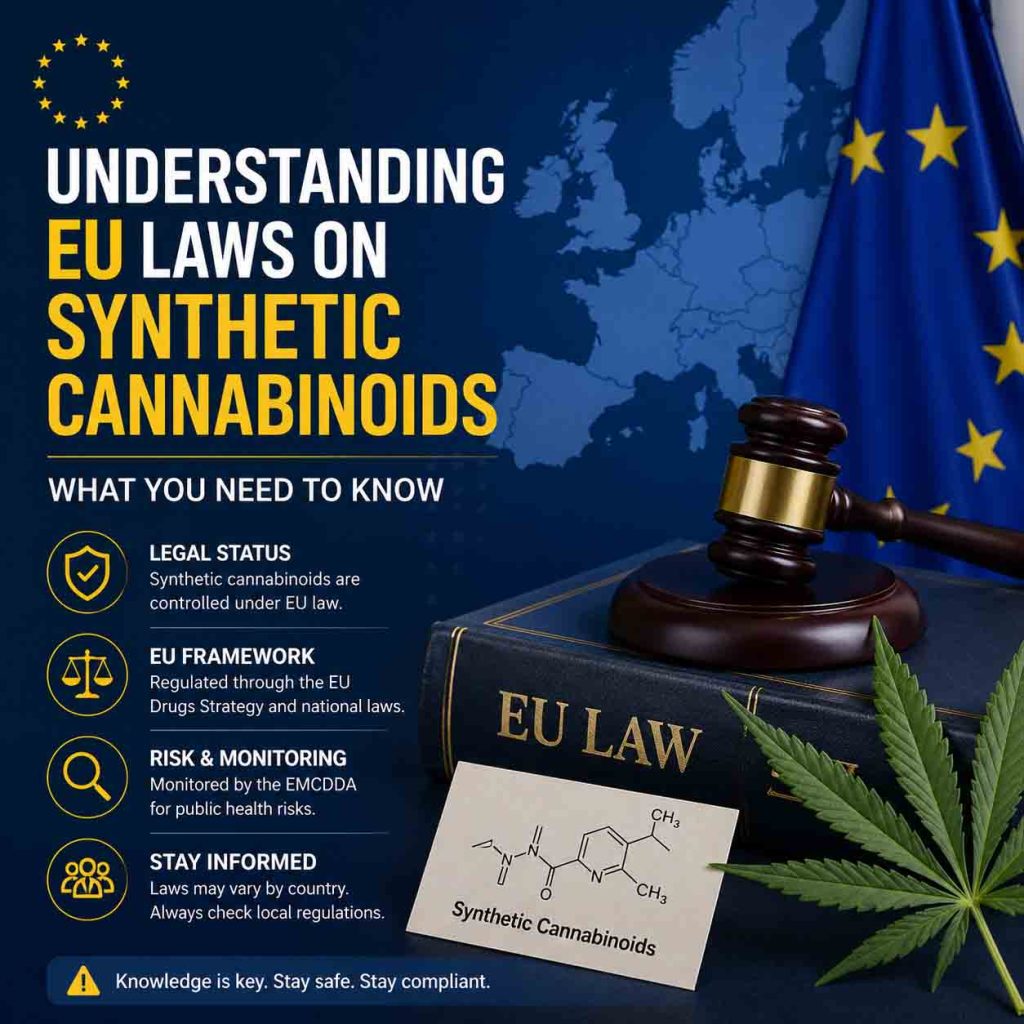
Understanding EU Laws on Synthetic Cannabinoids: What You Need to Know
Apr
Synthetic cannabinoids have become one of the most tightly regulated categories of psychoactive substances in Europe. Often marketed under names like K2, Spice, or herbal incense, these compounds sit at the center of evolving drug policy, public health concerns, and digital enforcement strategies.
Across the European Union, governments have moved beyond traditional drug scheduling and adopted broader legal frameworks designed to capture entire groups of psychoactive substances. As a result, understanding how these laws work is essential for researchers, readers, and anyone studying the regulatory environment surrounding synthetic cannabinoids.
This guide explains how European laws function in 2026, how enforcement differs across countries, and why regulatory bodies such as the European Monitoring Centre for Drugs and Drug Addiction play a key role in shaping policy.
What Are Synthetic Cannabinoids?
Synthetic cannabinoids are laboratory-created chemical compounds designed to interact with the same brain receptors as THC, the primary psychoactive compound in cannabis. However, they are structurally different from natural cannabis and often significantly more potent.
Unlike plant-based cannabis, synthetic cannabinoids are typically applied to dried plant material or dissolved into liquids. These products are then sold under misleading categories such as “herbal incense” or “potpourri,” even though their intended effects are pharmacological rather than aromatic.
Because of their variability, no two batches are guaranteed to contain the same chemical composition, which is one of the primary concerns for regulators across Europe.
How European Law Classifies Synthetic Cannabinoids
European countries have shifted away from listing individual compounds and instead focus on class-based or effect-based legislation. This means that rather than banning one chemical at a time, entire groups of substances can be controlled under broader legal definitions.
In many jurisdictions, synthetic cannabinoids fall under one of the following categories:
- New Psychoactive Substances (NPS)
- Controlled drug analogues
- Psychoactive substances under blanket bans
This approach was developed to address the rapid modification of chemical structures used to bypass older drug laws.
The EU-Wide Approach to Regulation
At the European level, regulation is coordinated but not fully harmonized. The European Monitoring Centre for Drugs and Drug Addiction plays a central role in monitoring emerging substances, sharing data between member states, and issuing early warnings.
However, actual enforcement is handled at the national level. This creates differences in penalties, classification methods, and enforcement intensity across Europe.
Despite these differences, there is a clear trend toward stricter and more unified control policies.
Key Legal Principles Used in Europe
1. Class-Based Bans
Instead of targeting a single molecule, laws may ban entire chemical families. This prevents minor modifications from creating “new legal versions” of banned substances.
2. Effect-Based Legislation
Some countries define illegality based on whether a substance produces psychoactive effects, regardless of its chemical structure.
3. Blanket Psychoactive Substance Laws
Countries like the UK have adopted laws that prohibit any substance capable of producing psychoactive effects unless specifically exempted.
4. Public Health Protection Model
Many EU policies are framed around reducing harm rather than simply punishing possession or distribution.
United Kingdom Example: Strict Blanket Ban
One of the most well-known frameworks is the Psychoactive Substances Act 2016, which made it illegal to produce, supply, or distribute any psychoactive substance not exempted under law.
This law effectively closed many of the loopholes previously used to sell synthetic cannabinoids under alternative branding.
Key points include:
- Broad definition of psychoactivity
- Strong enforcement against distribution networks
- Focus on supply chains rather than individual users
European Union Member State Variations
Although the EU provides coordination, each country applies its own legal framework.
Germany
Germany uses controlled substance scheduling and specific group bans. Enforcement is strict, especially for distribution and importation.
France
France uses rapid scheduling systems that allow authorities to quickly classify new substances as illegal. Enforcement is highly proactive.
Netherlands
While known for liberal cannabis policies, the Netherlands enforces strict bans on synthetic cannabinoids and continuously updates its controlled substance lists.
Spain
Spain has regional variation, but national law prohibits distribution and commercialization of synthetic cannabinoids.
Italy
Italy maintains a centralized drug control system with strict penalties for production and distribution.
Why Laws Keep Changing
Synthetic cannabinoids evolve quickly. Manufacturers often alter chemical structures slightly to avoid existing bans. In response, European governments continuously update their legal frameworks.
This creates a cycle:
- New compound appears
- Authorities assess risk
- Substance is banned or classed
- New variant emerges
To break this cycle, regulators increasingly rely on broad chemical definitions and psychoactive effect tests.
Enforcement Trends in 2026
Enforcement has expanded beyond physical markets into digital spaces. Authorities now monitor:
- Online marketplaces
- Social media platforms
- Cross-border shipments
- Payment processing systems
In addition, cooperation between EU states has improved, allowing faster response times to emerging substances.
Public Health Perspective
Synthetic cannabinoids are considered high-risk due to their unpredictability. According to monitoring data from the European Monitoring Centre for Drugs and Drug Addiction, these substances are associated with:
- Acute intoxication incidents
- Psychiatric symptoms
- Emergency medical cases
- Variability in chemical potency
This unpredictability is a major reason behind strict European regulation.
Commercial and Digital Compliance Considerations
For websites and informational platforms, compliance with both European law and search engine policies is critical.
Google prioritizes content that:
- Is informational and educational
- Avoids promoting illegal activity
- Provides clear context and safety awareness
Therefore, content should focus on:
- Legal education
- Risk awareness
- Regulatory updates
- Country comparisons
Your domain https://k2herbalhighs.com/ should be structured around informational authority + compliance-based education, rather than direct promotion.
Comparison: Europe vs Other Regulatory Models
| Region | Approach | Key Feature |
|---|---|---|
| Europe | Class-based + effect-based bans | Prevents chemical loopholes |
| United States | State + federal hybrid system | Mixed enforcement |
| Asia | Strict prohibition model | Heavy penalties |
Europe stands out for its adaptive and continuously evolving legal structure, designed specifically to respond to synthetic drug innovation.
Key Takeaways
- Synthetic cannabinoids are broadly regulated across Europe
- Laws focus on chemical classes and psychoactive effects
- The EU coordinates monitoring, but countries enforce independently
- The UK applies one of the strictest blanket bans
- Enforcement now includes online and cross-border monitoring
- Regulatory systems are designed to adapt to rapidly changing substances
FAQs
1. Are synthetic cannabinoids legal in Europe?
In most European countries, they are illegal under either specific bans or broad psychoactive substance laws.
2. Why are synthetic cannabinoids regulated so strictly?
Because they are unpredictable, often more potent than cannabis, and linked to health risks.
3. What does the EU do about synthetic cannabinoids?
The European Monitoring Centre for Drugs and Drug Addiction tracks and reports emerging substances across member states.
4. Is the law the same in every European country?
No, but most countries follow similar principles of class-based or effect-based bans.
5. What is the UK approach?
The UK uses a blanket prohibition under the Psychoactive Substances Act 2016.
6. Can chemical modifications make a substance legal?
Not anymore in most EU countries, due to class-based bans.
7. Are synthetic cannabinoids treated like cannabis?
No, they are regulated separately and often more strictly.
8. Why do laws keep changing?
Because new variants of synthetic cannabinoids continuously emerge.
9. Are online sales monitored in Europe?
Yes, enforcement now includes digital marketplaces and payment systems.
10. What is the safest way to understand these laws?
By following official government updates and EU monitoring reports.

Pingback: Synthetic Cannabinoids and the Liver: K2, Spice Toxicity Risks