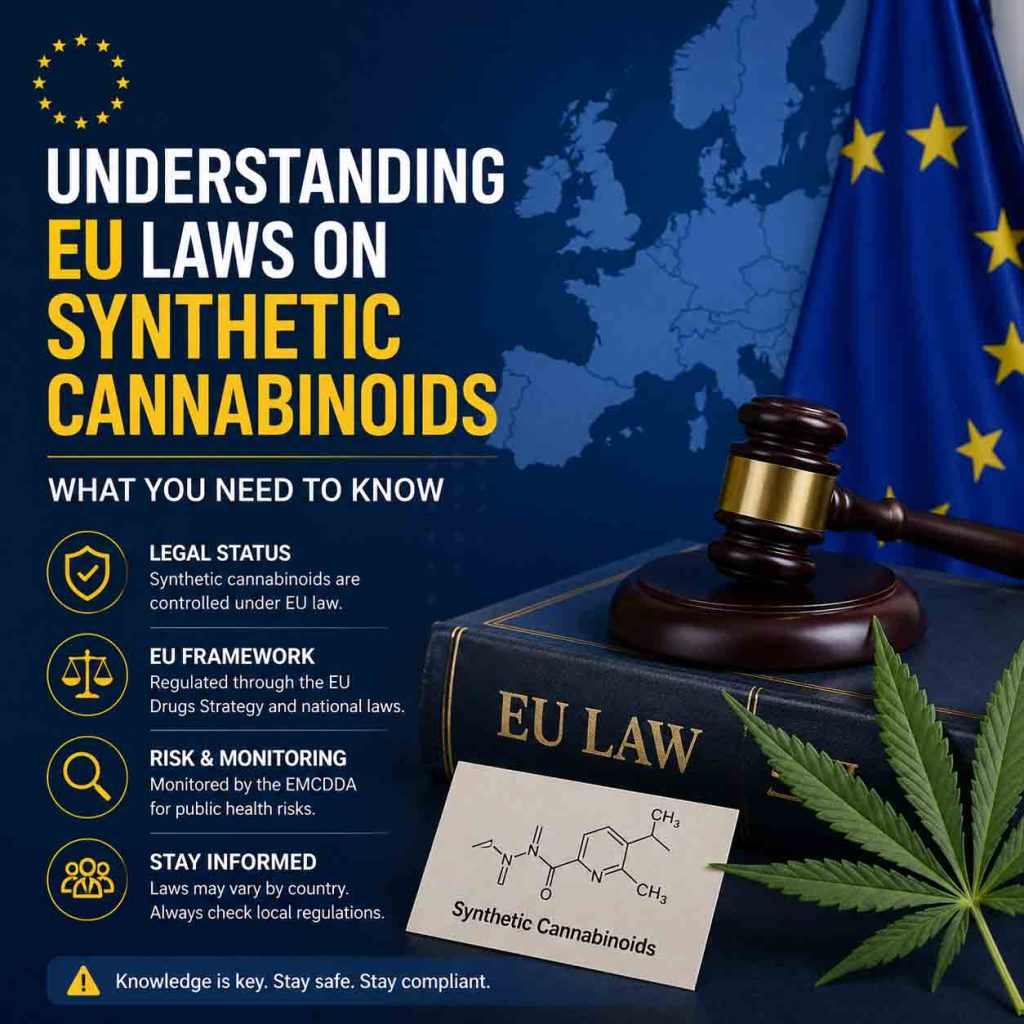
Synthetic cannabinoids have become one of the most tightly regulated categories of psychoactive substances in Europe. Often marketed under names like K2, Spice, or herbal incense, these compounds sit at the center of evolving drug policy, public health concerns, and digital enforcement strategies. Across the European Union, governments have moved beyond traditional drug scheduling and […]
Tag Archives: class based drug bans europe synthetic substances
Class Based Drug Bans in Europe, Synthetic Substances
Many European countries use class-based drug bans or similar legal models to control synthetic substances. Instead of banning only one chemical at a time, the law can prohibit an entire family of related compounds that share a core structure or similar effects. This approach was developed because new synthetic drugs were often slightly modified to evade older substance-by-substance bans.
Why Class-Based Bans Exist
Synthetic cannabinoids, synthetic stimulants, and other new psychoactive substances can be altered quickly in laboratories. If the law only bans one named molecule, manufacturers may release a near-identical version. Class-based laws help regulators respond faster by covering groups of compounds rather than chasing each new formula individually.
How It Works
A law may define a prohibited class using:
- shared chemical backbone or structure
- substitutions on certain parts of the molecule
- similar pharmacological effect
- analogue provisions for closely related compounds
This means a new synthetic blend may already be illegal even if its exact name is not yet widely known.
Europe Is Not Uniform
There is no single Europe-wide criminal code. Different countries use different systems:
- some rely on class bans
- some use analogue laws
- some use generic scheduling
- some use psychoactive substance bans based on effect rather than chemistry
Countries such as the United Kingdom, Germany, France, and others have adopted strong measures against synthetic substances through varying legal frameworks.
Bottom Line
Class-based bans are a major tool in Europe for controlling synthetic substances, especially synthetic cannabinoids. They make it harder to sell slightly modified chemicals as “new legal alternatives,” and many products can be illegal even when the exact compound name is unfamiliar.